Dronehab inspects structures and plant with a 100-megapixel medium-format camera, a 34× optical zoom camera, a radiometric thermal sensor and LiDAR, and returns a located, rated defect register rather than a hard drive of photographs.
Whatever is inspected today by elevated work platform, rope access, scaffold or shutdown can usually be inspected faster from the air, with no one at height and the asset kept in service. Findings are measured where they can be — temperature, dimension, clearance — located to asset and component, rated for severity, and handed over in the format your maintenance system already uses.
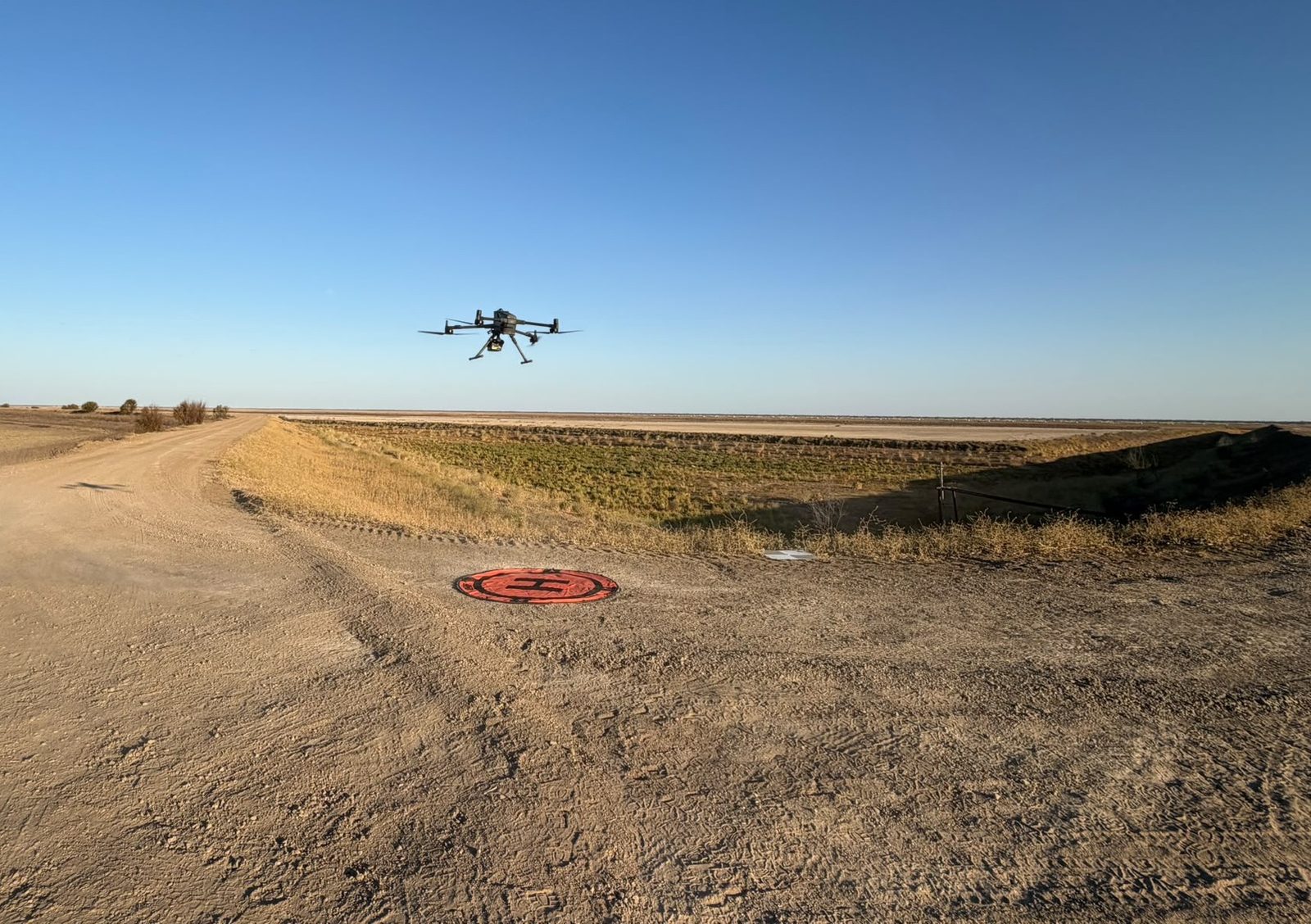
The inspection pass replaces the EWP, the rope team and the scaffold. The residual risk sits with the aircraft, flown at a planned standoff and never in contact with the asset.
A conveyor, an energised line or a flare stack can be inspected while operating, because nothing touches it. Isolation is only needed where your own rules require it.
Every finding is located, measured where possible, rated and given a recommended action — so the output is a work list, not a review task.
What we inspect
 Powerlines, towers & substations
Insulators, conductors, fittings and dampers; tower steel, bolts and foundations; thermal on joints, clamps and substation plant — all from outside the exclusion zone set by the network operator.
Wind turbines Blade leading-edge erosion, lightning damage, cracking and surface defects, with the rotor parked and blades positioned by your operator; nacelle, hub and tower condition; thermal on blade structure and drivetrain housing.
Mine fixed plant & conveyors CHPP structures, conveyor gantries, transfer towers, bins and stackers: structural steel, idlers and belt edge by zoom, hot bearings and motors by thermal — flown while the plant is running.
Mine mobile plant Dragline booms, lacings and masts; shovel and excavator booms; dozer and loader pins, bearings and hydraulics — thermal for friction heat, zoom for cracks, bolts and wear, without putting a fitter on the boom.
Pipelines, tanks & stacks Corridor condition, supports, coatings and leak indicators; tank shell and roof plate; flare stacks and chimneys at height without a shutdown or a climb.
Bridges & civil structures Deck soffits, bearings, piers and abutments; culverts, retaining walls, dam faces and spillways — cracking, spalling, scour, seepage and vegetation.
Telecoms towers Antenna, mount and feeder condition; structural members, bolts and guy attachments; corrosion, bird damage and unauthorised equipment.
Buildings, roofs & facades Roof sheeting, flashings, gutters and rooftop plant; facade cracking, sealant and glazing; thermal for moisture ingress and insulation failure.
If it is currently inspected at height, over water, or only during a shutdown, it is a candidate. If it is not on this list, ask.
From flight to work order
Scope
Asset list, drawings, prior reports and the defects you care about. Standoff, exclusion zones and load state agreed with the owner.
Capture
Planned passes at the agreed standoff: 100 MP and zoom for surface detail, thermal under load, LiDAR where geometry matters. Every frame geotagged.
Analyse
Frames reviewed component by component. Defects measured where possible — ΔT, dimension, clearance — and rated for severity.
Report
Register, evidence pack, model and recommended actions issued. Baseline kept for the next campaign.
Primary inspection camera — Phase One iXM-100 · RSM 80 mm. 100 MP medium-format, 11,664 × 8,750 px on a 43.9 × 32.9 mm BSI sensor. 83 dB dynamic range, leaf shutter to 1/2500 s, 3 fps. A whole structure face in a handful of frames at sub-millimetre detail, with sunlit and shadowed steel held in one exposure. The same frames build the photogrammetric 3D model of the asset.
Sensors — what each one is for
- Zoom RGB
- 34× optical, 33–809 mm equivalent, up to 400× hybrid. Surface cracking, corrosion, fastener condition, wear and coating breakdown, read from standoff at hand-held detail.
- Radiometric thermal
- 1280 × 1024, ≤ 50 mK, temperature in every pixel. Hot joints and clamps, bearing and pin friction heat, motor and gearbox temperature, moisture ingress — measured as ΔT, not judged by colour.
- LiDAR
- Zenmuse L3, ± 10 mm ranging accuracy. Structural geometry, deflection and clearance; an as-is 3D model so a finding sits on the structure, not just in a photo.
- Laser rangefinder
- 3–3,000 m. Standoff distance held and logged; every finding coordinated to the asset.
Resolution at standoff — iXM-100
Hairline cracks, weld toes, bolt markings.
A tower face or conveyor bay per frame at cable-tie detail.
Whole-asset coverage at paint-chip detail. 80 mm RSM lens, 3.76 µm pixels.
Standoff
Standoff distances set with the asset owner; the aircraft never contacts the asset.
Controls
Job-specific SWMS, exclusion zones, spotters where required. Mine-inducted crews, CASA ReOC operations.
Load & conditions
Thermal flown with plant under load, conditions logged — a hot bearing is a hot bearing, not a sunny afternoon.
A defect register, not a hard drive
- Defect register
- CSV / XLSX ready for CMMS import — asset, component, finding, measurement, severity, recommended action and evidence reference per record.
- Evidence pack
- Zoom and thermal frames per finding, annotated and located; radiometric files retained for re-analysis.
- Model & orthos
- LiDAR or photogrammetric 3D model of the structure where scoped; georeferenced orthomosaics for linear and area assets.
- Report
- PDF with scope, conditions, equipment, method, findings by asset and severity, and limitations.
| ID | Asset · component | Finding | Measure | Sev. | Action |
|---|---|---|---|---|---|
| D-0027 | CV-03 · gantry bay 14 · idler | Elevated bearing temperature | ΔT 31.4 °C | 3 | Priority inspection / replace idler |
| D-0031 | Tower T-118 · leg C, waist | Corrosion, section loss suspected | — | 2 | Close inspection / thickness test |
| D-0040 | TK-2 · roof plate, NE quadrant | Coating breakdown, pitting | ~0.4 m² | 2 | Monitor / recoat at next outage |
Sample register format — example values only.
Severity
No defect or cosmetic only. Logged for the baseline.
Defect present, no immediate action. Re-inspect next campaign.
Schedule repair or close inspection within the maintenance window.
Safety or operational risk. Immediate referral to the asset owner.
Mapped to your own asset-management scale where you have one. Findings are reported as observations and suspected causes; root cause is confirmed by the close inspection the register directs.
What we need from you
- Asset data
- Asset list with IDs, drawings or models, and prior inspection reports where they exist.
- Access & rules
- Site access and inductions, exclusion zones and standoff distances, and an owner’s contact for Severity 4 findings on the day.
- Load state
- Plant running for thermal where your rules permit; rotor parked and blades positioned for turbines.
Certified, registered, site-ready
Aerial platforms
- DJI Matrice 400 — primary
- Phase One iXM-100 — 100 MP medium-format, RSM 80 mm
- Zenmuse H30T — 34× optical zoom, 1280 × 1024 radiometric thermal, laser rangefinder
- Zenmuse L3 LiDAR — ± 10 mm ranging, 100 MP RGB
- DJI Matrice 4T — rapid and confined sites; 640 × 512 radiometric thermal, 48 MP zoom
- RTK positioning on both platforms
Processing
- Radiometric R-JPEG analysis
- Photogrammetric and LiDAR 3D models
- GIS referencing to asset register
- Defect register and field layers
- Baseline-to-campaign comparison
Same contractor
- Survey, as-built and LiDAR
- Solar PV thermography
- Thermal fauna detection
- Vegetation mapping and weed control
- One mobilisation, one coordinate framework
- CASA ReOC holder — ARN 1210588. Chief Remote Pilot and RePL holder — ARN 1210579.
- Engineering registration — RPEQ, in-house.
- Safety record — zero recordable injuries since operations commenced in May 2023. Mine-inducted crews, job-specific SWMS.
- Supplier systems — Avetta · Pegasus / Onsite Track Easy · ICN Gateway (Business ID 1890843).
- Data handling — all project data held commercial-in-confidence.
- Locations — crews mobilise from Mackay QLD, Brisbane QLD, Gold Coast QLD and Sydney NSW.
Capability statementThe full UAV Asset Inspection capability statement — scope, method, sensors, deliverables and credentials — for tender packs and procurement.
Drone asset inspection questions
What assets can you inspect by drone?
Powerlines, towers and substations; wind turbines; mine fixed plant, conveyors and mobile plant; pipelines, tanks and stacks; bridges, dams and civil structures; telecoms towers; and buildings, roofs and facades. If it is currently inspected at height, over water or only during a shutdown, it is a candidate.
Does the plant need to be shut down?
Usually not. Nothing touches the asset, so conveyors, energised lines and flare stacks can be inspected while operating, and thermal is deliberately flown with plant under load. Isolation is only needed where your own rules require it; for wind turbines the rotor is parked and blades positioned by your operator.
How close does the aircraft get?
Standoff is set with the asset owner and held with a laser rangefinder, typically 10–50 m. At 10 m the 100 MP camera resolves 0.5 mm per pixel — hairline cracks, weld toes and bolt markings; at 50 m it still covers a whole asset at paint-chip detail. The aircraft never contacts the asset.
What do we get back?
A defect register in CSV / XLSX ready for CMMS import, an evidence pack of annotated zoom and thermal frames per finding, a LiDAR or photogrammetric 3D model and orthomosaics where scoped, and a PDF report covering scope, conditions, equipment, method, findings by asset and severity, and limitations.
How are findings rated?
Severity 1–4: Record, Monitor, Plan, Act — mapped to your own asset-management scale where you have one. Findings are reported as observations and suspected causes, with measurements where they can be taken (ΔT, dimension, clearance); root cause is confirmed by the close inspection the register directs.
Can you work on mine sites and near energised lines?
Yes. Crews are mine-inducted and work under job-specific SWMS, exclusion zones set by the network operator and spotters where required, under CASA ReOC operations. Dronehab is registered on Avetta, Pegasus / Onsite Track Easy and ICN Gateway, with zero recordable injuries since operations commenced in May 2023. Call 1300 544 968 or send your asset list for a fixed quote within one business day.
Where this fits
Image credits
Asset photography is illustrative of the asset classes and is not Dronehab project imagery. Via Wikimedia Commons: High voltage switchgear, Novoklimov (CC0) · Wind turbine at the CSIRO Energy Centre, Nick Pitsas, CSIRO (CC BY 3.0) · Conveyor carrying load onto a storage pile, CSIRO (CC BY 3.0) · Dragline, Luminant Energy Kosse lignite mine, Roy Luck (CC BY 2.0) · Section of the Perth–Kalgoorlie water supply pipeline, Willem van Aken, CSIRO (CC BY 3.0) · Tinaroo Dam discharge, Jack Bain (CC BY 4.0) · Cellular telephone tower, Knoxville, David Ratledge (CC BY 4.0) · Glass building corner, Jonathan Simcoe (CC0). Thermal, aircraft and crew imagery © Dronehab Pty Ltd.