Radiometric thermal adds a layer the eye can’t see — surface heat. Flown day or night, it pinpoints heat anomalies across a site and reveals warm-blooded animals against a cool background, supporting both operational inspection and ecological survey.
Zenmuse H30T on the Matrice 400, with the Matrice 4T for rapid response — radiometric thermal paired with RGB and zoom for identification.
Georeferenced thermal mosaics, anomaly / detection maps, GIS layers.
Day or night to suit the target — CASA-certified operations under our ReOC.
Thermal survey and thermal fauna surveys
Thermal survey
Calibrated, georeferenced thermal mapping and targeted inspection across operational and rehabilitated land.
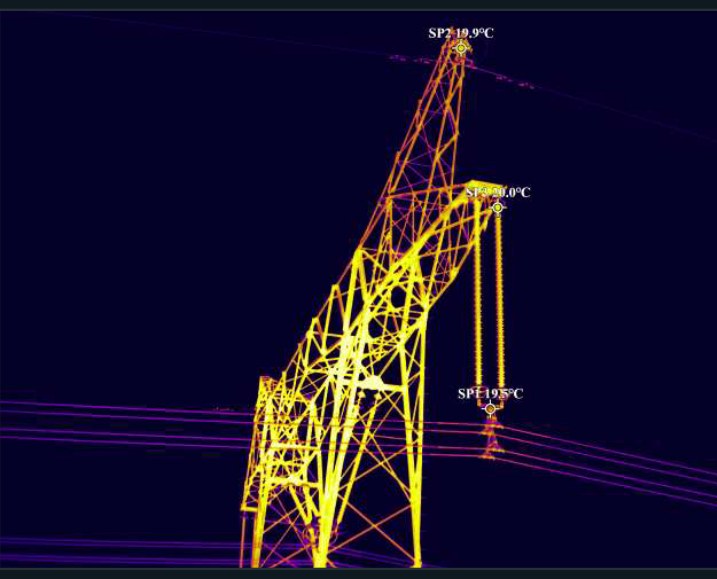
- Hot-spot and spontaneous-combustion detection in spoil and stockpiles
- Electrical, mechanical and conveyor inspection
- Water, seepage and moisture mapping
- Fire-scar and post-burn assessment
Thermal fauna surveys
Heat-signature detection of nocturnal and cryptic fauna, flown at dawn, dusk or night for maximum thermal contrast.
- Koala, glider, macropod and feral-animal detection
- Pre-clearance and pre-disturbance fauna spotting
- Presence, distribution and relative abundance
- RGB-confirmed and reviewed by our ecologist / SQP

Koala thermal detection & nest box monitoring
Drone-mounted radiometric thermal finds warm-bodied arboreal fauna against a cool night canopy; a 168 mm-equivalent zoom confirms species from stand-off. The same aircraft reads Greater Glider nest boxes externally — no climbing, no elevated work platform, no disturbance to the animals or the boxes — and every detection lands as georeferenced, auditable evidence: paired thermal and RGB imagery, a register aligned to offset area management plan (OAMP) record fields, and GIS layers prepared to the Commonwealth Guidelines for Biological Survey and Mapped Data. Offered as a complement to the physical and visual inspection methods prescribed in approved management plans.
Detect
Pre-dawn thermal transects across target habitat, flown when body-to-canopy contrast is strongest — cool, still, dry nights, year-round.
Confirm
Each thermal target is held at stand-off and interrogated with the tele camera to confirm species — koala, glider, possum or non-target.
Screen boxes
A morning round reads each box’s entrance and walls for occupant heat after overnight cooling; RGB stills record external condition box by box.
Deliver
Reads are matched to your register by position and camera pointing, so every round repeats the same geometry and the dataset builds as a living GIS layer.
DJI Matrice 4T — sub-2 kg platform. 640 × 512 radiometric thermal, Super-Resolution to 1,280 × 1,024, R-JPEG with per-pixel temperature; 48 MP zoom to 168 mm equivalent with laser rangefinder.
Paired thermal / RGB evidence per detection · nest box register on OAMP record fields · Google Earth KMZ with embedded imagery · GDA2020 GIS layers with metadata.
Pre-dawn and night windows to suit the target, year-round on cool nights — CASA-certified operations under Dronehab’s ReOC (CASR Part 101).
Proven in the field — Bowen Basin offset program, winter 2026. On a proof-of-concept survey across a coal-mining offset area in Central Queensland (client confidential), a single pre-dawn session at ≈6 °C ambient detected and confirmed three koalas in roughly 80 minutes of transects — each verified to species by zoom and delivered with a georeferenced position — and externally screened ten Greater Glider nest boxes at 9–28 m hold-off, flagging one box with a thermal signature consistent with occupancy for follow-up.
- Survey design per the Commonwealth Survey Guidelines for Australia’s Threatened Mammals; effort recorded against the guideline.
- Spatial outputs prepared to the Guidelines for Biological Survey and Mapped Data (2018) — ready for compliance reporting and departmental submission.
- Method supported by peer-reviewed thermal-drone studies — Corcoran et al. 2019, Scientific Reports; Wagner et al. 2025, Ecological Applications.
- Offered as a complement to prescribed monitoring; where substitution is sought, we support the management-plan revision pathway with the evidence base regulators expect.
- Internal box condition, breeding and pest use remain the province of ecologist inspection — thermal screening extends coverage and cadence alongside it.